Friday, May 15, 2015

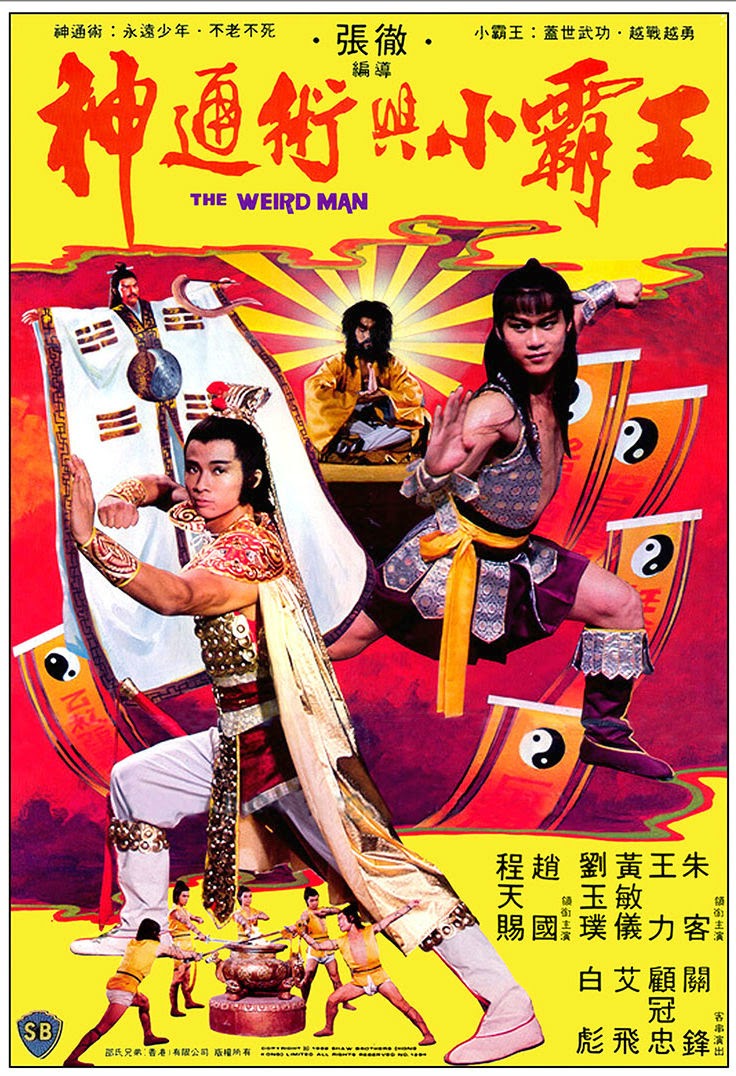
The Weird Man (Shen tong shu yu bao xiao wang, 1983)


Howdy Hai!Karate faithful!!! As you well know, we strive to cover martial arts films in their glory - and also in their shame and schlock. The next film we're going to chop it up about falls more towards the latter than the former in this regard. And that film is The Weird Man, straight from the latter days of the Shaw Brothers Studio motion picture era!! The film stars Ricky Cheng Tien-Chi, Jason Pai Piao. Chu Ko and Wong Lik at the forefront of the cast. The director is none other than the renowned Chang Cheh. The film is apparently based on the ancient Chinese historical novel, Romance of The Three Kingdoms. The novel itself is a chronicle of events surrounding the fall of the Han Dynasty and the three super-states Cao Wei, Shu Han and Eastern Wu that rose to power afterwards starting in 169 A.D. to 280 A.D. The film is supposed to be Cheh's own vision of those events. But after seeing the film, I wondered about his sight for real. Before I get into that, let's dive into the plot shall we?


The Weird Man begins with court intrigue as Prime Minister Cao Cao (Pai Piao) plots to assassinate General Sun Ce(Chiu Gwok). But his plans are discovered by Taoist priest Zuo Ci(Kwan Feng). It would seem that it is too late, as Sun is ambushed in the forest but SOMEHOW survives a mess of arrows to the chest. As he is brought home to recuperate, Zuo Ci goes to Master Yu Ji(Tien-Chi) who is in seclusion with his six students. At Zuo Ci's request, Yu Ji goes out among the people of the countryside. Yu Ji knows that doing so will bring about his death, but it is ordained. He enters the city and performs miracles, extracting poison and illness from people by touch alone.(Apparently both are Nickelodeon styled green slime.) General Sun hears that the people have proclaimed him to be God, and so orders his beheading. Magistrate Xu Gong(Lik) implores him to hold off, and Sun does - only if he can bring the rain. Yu Ji is imprisoned on a bale of hay in the square. He brings the rain down, but Sun orders him beheaded anyway. Magistrate Xu goes to the 6 disciples and tells them where his body is. They retrieve it, and let it float inside of a milky pool within the temple where it JOINS with his decapitated head. Yu Ji then tells the disciples that his spirit is still in limbo, and that they've been betrayed by Xu Gong. And so, he sets forth as a spirit warrior with an impish side to set things straight...


Annnnnnnnnnnnnnnnnnnnnnnnnnnnd that's about the time that things go off the road, Sega Outrun style. Master Yu Ji becoming this hyper-athletic fighter using the general's wife to seduce the general, complete with baby oil. BABY OIL. The film basically becomes a mish-mash of comedy, intrigue with action that has a tinge of slapstick. Add some wild special effects like heavy mood lighting, and radio serial music cues and The Weird Man...just gets weird. Now if you get a chance to watch the dubbed version, the dialogue essentially makes Yu Ji out to be like Jesus Christ. I don't know if that was the aim of Cheh and the team behind this flick had that intention, but for a good part of the film Yu Ji does look like an Taoist Jesus complete with the hair. Or like one of The Wild Samoans from the WWE days with lap band surgery. But that's not even most of the confusion. The film seems to focus on the mischief Yu Ji's soul gets into, especially with the general's wife and her sister, even to the point of having Tien-Chi dress as them both. And General Sun, who's supposed to be heroic, becomes a villain and yet is still a heroic figure to be pitied? Huh? Cheh was truly all over the place with this picture. Tien-Chi at this point was essentially in the mode where he was the star, but wasn't really considered leading man material all the way, save for his sharp turn in Five Element Ninjas. Here, he gets to show off his comedic skills and some solid fighting chops that kept him working for years. One smart move was making him the action choreographer; he emphasizes a lot of his acrobatics, and makes those scenes engaging. Chiu Gwok as a lead...nah. He was more of a role player and it showed here.


All in all, The Weird Man is one of those latter Shaw-era films that was all about special effects and the idea of throwing actors and a script together and making it stick. Or trying to. And it didn't help that Cheh's style of directing and making films showed its age in a bad way. This is one of those films that you can watch once and(if you get through it)never need to see again. It's available on DVD and online.

RATING: 2 OF 5 DRAGON PUNCHES

Friday, May 8, 2015

The Blazing Temple (Feng Shiu Shiu Lam Chi, 1976)


What's good, good people?!! Hai!Karate returns with a burning classic in the genre of martial arts films, The Blazing Temple!! The 1976 flick is a cavalcade of stars including Chang Yi, Carter Wong, Judy Lee and Kam Kong, and is directed by the noted Joseph Kuo!


The Blazing Temple starts out with a slight bit of confusion; we see the film open on the emperor(Yee Yuen) and his entourage. He's just been informed that the 8 Swordsmen, along with other members of the Shaolin Temple, are training heavily to take down the Manchu Empire. This of course enrages his highness, who all of a sudden gets ambushed by Miss Yu(Lee) who swears to take his head in response to his decree to eliminate her entire family for conspiring with the rebels. Cue throwdown. We then jump to the Shaolin Temple and find the rebels joking with each other and discussing how they came there during a lull in training. Of course, this gets interrupted by the Manchu forces surging to attack. And what an attack it is; the entire temple is assaulted, and we see various disciples trying to save precious Buddhist texts. Word gets to the chief abbots, and they press the remaining disciples deep in the catacombs to train harder. The supreme abbot, even though there is a secret tunnel to freedom, demands that the only way out for them is through...the Bronzemen!!!


The disciples begin the process of trying to break through the Bronzemen and the rest of the trials, but the supreme abbot is chastised by others for being so stubborn to stick to tradition in a dire time. He relents, and goes to the tunnel only to find it blocked by a massive boulder. He makes the supreme sacrifice, and the 8 Swordsmen leave to go find the emperor and assasinate him. But the fight won't be easy - twists and turns beset them, especially the fact that there could be a traitor in their midst. Can they succeed against the cunning of Emperor Yungzheng and the Manchu forces?

To be real, The Blazing Temple is good, not great. It stands out because it's one of the few films if not the only one, to actually make the destruction of the Shaolin Temple a central setting within the film. Others, you see a glimpse of the chaos or it's spoken of and not really drawn out with the exception of Shaolin Abbot three years later. Kuo, who would go on to helm other classics like The Mystery Of Chessboxing, does okay here. The action scenes are crisp and increase in brutal effect as the film goes on.(Side note - cats catch severe bad ones starting with the Bronzemen sequence.) What had me flip was Judy Lee basically being at the start of the picture and then she makes no real appearance UNTIL THE FINAL FIVE MINUTES. I wasn't overly mad at her entrance though, that wire-fu was serious. Chang Yi puts in good work here, displaying a lot of emotion. If you've read this blog from jump, there's times where I've called him too damn stoic. Not here though, you get tears and everything from him. Carter Wong as Siu is the hidden gem of the picture. This was the beginning of Carter's prime in Hong Kong cinema, where he could be counted on to deliver solid performances that caught the audience's eye. And here he makes sure not to oversell his acting, and to also be thoroughly acrobatic with his fighting. Which is probably why he got the prominent spot on most DVD covers of the film. I do believe that this is one of those flicks that anyone who's a martial arts film fan will want to see if they haven't already just to add to their knowledge. The Blazing Temple is available on DVD, and online if you don't want to pay the freight.
RATING: 3 OF 5 DRAGON PUNCHES

Wednesday, April 29, 2015

That Daredevil Fight Scene Tho'...


What's happening folks? For this post on Hai!Karate, I wanted to touch on the explosive success of Netflix's latest series, the highly anticipated new TV entry from the Marvel Cinematic Universe, Daredevil. Now, if you haven't watched ANY of the series yet, I am inclined to post this for your benefit so you can click away and I don't have to hear any nonsense:
SPOILER ALERT!!
SPOILER ALERT!!
SPOILER ALERT!!
Now that that's out of the way...Daredevil has been getting rave reviews from almost everyone I've talked to. From the inspired casting of Charlie Cox as Matt Murdock to Vincent D'Onofrio as Wilson Fisk, to the dialogue, to the plot twists - the series is one of the best to break out of the gate in quite some time. Does it help that the full season uploading policy by Netflix gets more viewers? Probably. But I think that the same accolades would be in place if this was set up week by week in traditional form. The series is a gritty crime drama, hard-nosed to the point that you can smell the musky damp air of Hell's Kitchen at night. Of course, the major draw of Daredevil are the fight scenes. The first episode alone had me on the edge of my seat with every second of those battles. Major props have to go to the entire stunt team and their fight choreographer, Philip J. Silvera, whose work was recently on display in Thor:The Dark World and The Dark Knight Rises. Which brings me to the bit that has captured the imagination of many: the fight scene at the end of episode 2 where Matt goes up against the Russians for the first time. That scene is the centerpiece of "Cut Man", an episode that lets viewers get even more of the complexity of Matt Murdock's background. I've seen some commentary from a couple of bloggers about how that it's the greatest fight scene EVER. *record scratch*

Some of you need to have a seat and sit the next couple of plays out.


Listen. The fight scene is a thing of beauty. It is a testament to the work of all involved. But you CANNOT sit there and pull a generational amnesiac move and proclaim it as the 'best fight scene ever.'Do you understand how stupid that sounds, given the history of martial arts cinema? It's symptomatic of the thinking and writing I've been seeing these past few months in terms of kung-fu flicks and related movies. You know what I'm talking about - those lists by other magazines and websites. Lists that are as suspect as Donald Trump doing the Cupid Shuffle on Dr.Martin Luther King Jr's birthday. More on that in a sec. The fight scene in 'Cut Man' was brolic beyond words, no question. But you don't get that fight scene on an American television show without acknowledging the heavy influence from three distinct areas. First, the Indonesian martial arts/crime thrillers The Raid and The Raid 2. Second, Tony Jaa and his output of films from Thailand. And lastly, District B13 and the rise of parkour. All of those elements are at play in that scene, done in one long contiguous take. If you were on the fence about the show from the first episode, that moment was the one that pulled you in all the way. But let's keep it funky. That scene's greatness should not get put on a pedestal above the countless other moments in martial arts movie history. And yes, you can make that statement and not be a 'hater' or whatever else you pop-culture crazed mofos with no sense would say. Which leads me to the next decision...

Hai!Karate is going to do it's OWN LIST. Yes, I'm tired of these cat-in-the-hat ass lists from folks that haven't appreciated or seen the full scope of the movies. The list will contain thirty entries, counting down to number one, split into three posts. That's going to take place over the course of the next month, with alloawances for other work I've got going. SO...if you're a fan of this blog, tell a friend. Tell ten. Because we plan to GO IN.

Thursday, March 26, 2015

The Tournament (Zhong tai quan tan sheng si zhan, 1974)


What's going on, folks?!! We've got another veritable must-see film here for you on Hai!Karate...one of our favorites over here and a choice one for Women's History Month. On the screen tonight? The Tournament, starring the legendary Angela Mao Ying!!! This picture also boasts a who's who of kung fu movies, such as Carter Wong, Sammo Hung, Whang In Sik and others. This film is chock full of hardcore action with some great twists, so let's dive right into it!


The Tournament begins with a shady deal going down in the streets of Hong Kong. Apparently, bookies in Bangkok, Thailand need someone to go fight there. They strong-arm one guy into doing it over some gambling debts. But first, he has to clear it with his master as is customary with all Chinese boxing associations. Master Siu-Fung(Got Heung-Ting)gives the okay for him and his son(Wong) to go to Thailand to enter a Muay Thai contest - without the knowledge of the boxing association. Both men go, and get the ever-loving crap kicked out of them. An onlooker tells the association, who mostly disavows Master siu-Fung for 'disgracing Chinese boxing.' The backlash wrecks his name, and ruins the arranged marriage of Lau Siu-Fung(Mao Ying) and the son of a fellow master(the smarmy Chiang Nan). Despite some comfort and support from the association president(Guan Shan), the master is so despondent that he commits suicide.


Distraught, Lau takes it upon herself to restore the honor of her father along with her brother, and so they both make the decision to go to Thailand. This goes against the wishes of the association, who try to stop her to no avail. In other words? She DESTROYS all of them. Soon after, they hit Bangkok and begin to train for combat in the Muay Thai ring. But intrigue in Bangkok complete with run-ins with the gang responsible for the mess along with trouble at home thanks to a Japanese karate master(In Sik)hellbent on seizing the Siu-Fung residence to be his own dojo, makes for a daunting series of battles ahead for Lau Siu-Fung...


Honestly, this film is major on so many levels. For starters, it's yet another Hong Kong martial arts film that would incorporate Muay Thai as a main part of the story. Prior to that, you only saw it in Duel Of Fists and The Angry Guest from Shaw Studios. It would lead to Muay Thai being a concrete part of martial arts cinema going forward. To that end, the biggest revelation is when Lau Siu-Fung takes it upon herself to learn the art. And that leads us to another big moment...


Angela Mao with SHORT HAIR. Now, this may not seem like much, but at the time it was revolutionary. There were films where women took on men's roles, it was quite common. But in this role, Angela's short cut was striking.(And it didn't distract from how lovely she was - first reaction I had was oooooooooh-WEE when I saw it).Striking because over the course of the film, Lau redefines herself immensely. She begins the film as a dutiful daughter, willing to be in an arranged marriage with someone who isn't realllllllllly a good match for her, to a fierce fighter who in effect supplants her brother as the master-in-charge. It's a bold plot even in an era where it was seemingly progressive for women in cinema. This gets underscored by her actual Muay Thai training and being in the ring - she addresses the Thai press in a smart blouse and slacks, and carries herself with the utmost confidence. Angela's fighting skills are put to great usage in The Tournament. One standout fight besides her Muay Thai match is when she goes toe to toe with veteran actor Wilson Tong on the fixed poles. It's HER FILM from the moment she begins her first scene, full of steely determination, impressive fighting and charm that truly mesmerizes. I mean, Carter Wong gets shunted aside rather quickly, which is a bit surprising but when you consider Angela's prowess, not that much.


The Tournament does have its odd points - Whang In Sik raids the Siu-Fung house with a burly white dude in tow(George Yakirian) in a slightly laughable way. Then you have the abject dismissal on the part of the association against Siu-Fung - it's like, wouldn't you ASK why he did what he did in a heavier investigation? Also, the gang business in Thailand is a bit of a minor thing in the second half of the film. There's even a 'meta' moment involving Golden Harvest Studios themselves. But if it's brutal action you want, the fight choreography by Sammo Hung gives that to you in spades. (Side note: Sammo would outfit actors with shin guards and demand that they deliver full-on kicks to give off that extra realness, as was custom in shooting these films.) THe Muay Thai scenes are done really well, with a keen technical eye. It's also interesting to note the different players in the picture - you can spot a young Yung Biao here and there in the film(Side note:he actually did double for Angela in a couple of acrobatic scenes). I highly recommend The Tournament for all martial arts film fans, as yet another example of how thoroughly bad-ass Angela Mao Ying truly was. It's available online and on DVD!

RATING: 4 OF 5 DRAGON PUNCHES

Sunday, March 22, 2015

Queen Boxer (The Avenger, 1972)


What's good people? Hai! Karate comes back with another madcap martial arts film to cover, and being that it is Women's History Month, we're going to get into a key film in the career of the Iron Phoenix, Judy Lee aka Chia Ling!! The film? Queen Boxer!! This flick comes to the public straight from the independent Fung Ming Motion Picture Company. Now there's a couple of reasons why this film gets a look here, and we'll cover those soon. But first - the action!!


Queen Boxer begins with a fighter by the name of Ma Yu Chen who heads to a restaurant to settle a score with the big boss(Lee Ying) and his gang of cutthroats. Now cutthroats as a term applies 'cause after Yu Chen wrecks the squad on hand, he somehow gets ambushed and winds up dead in a gruesome manner. It turns out that this group happens to be the infamous Axe Gang of Shanghai. And on their rampage, they happen to massacre a family. But what they didn't plan on was, that one member of the family would get wind of this - and seek revenge.


Ma Su Chen(Lee) arrives in Shanghai after a slightly drawn-out intro complete with a jacking of Issac Hayes' 'Shaft Theme'. It's not the only bit of music that was boosted, as we'll get to. Su Chen comes to rest at a rice bun shop run by Fan Kao To(Peter Yang Kwan), a local who is fed up with gangs trying to terrorize folks to the point where he refuses to pay protection. As he stands up to the Axe Gang subordinates, Su Chen winds up fighting off one or two of them herself, performing a bit of instant dentistry in one case. Kao To winds up running a casino due to his stance, and he and Su Chen wind up teaming up to fight the big boss and the rest of the Axe Gang for some overdue justice.


I won't lie to you - Queen Boxer does have some snooze-worthy parts to it. Lee gets introduced early, and doesn't have much major action until nearly halfway through. Now - she DOES thoroughly bust some heads in this flick. Lee proves exceptional when it comes to handling knives, as evidenced in one scene where she catches a blade and whirls to take out someone in a fluid motion. She stands out in this picture, and while it's not hard to do given the cast(Yang Kwan is aight, but no one else really grabs you), the film does stand out because of her. The action director, Wu-Min Hsiung, more than likely just told her, 'we're going to really highlight how fierce you are - so go get em!' This sentiment was probably shared by the director, Florence Yu Fung-Chi - who also happened to be the producer. She and the Fung Ming company would have this as their only spark of notice, a spark that got snuffed out quickly because of some fibs being told. First one? The film got advertised as a 'sequel' to Shaw Studios' Boxer From Shantung, which starred Chen Kuan-Tai and was a hit that same year. Another aspect was how Judy Lee got her Western moniker. Apparently, Fung Ming(which was owned by both Fung-Chi and Peter Yang Kwan)was looking to maximize their profits with the film. That's why they jacked music not only from Issac Hayes, but also from Shaw flicks and others. It explained why, according to legend, they shot the film in ELEVEN days. And it also was the motive behind making Chia Ling as Judy Lee in order to pass her off as the iconic Bruce Lee's sister in promotions for the film. When the jig was up, Judy wound up being the scapegoat and drew the wrath of those fooled in Taiwan and Hong Kong. Now it is up for debate whether the film company did this on purpose. In any event, Judy dealt with the situation as best as possible. A tough thing when it is your first film. As for Florence Yu Fung-Chi, it was her attempt to be a major director and producer, a tough go for a woman - this was the time where women didn't have the higher prominence outside of acting, not until Mona Fong's rise with Shaw Studios a couple of years later. Not even her prior work as a minor role actress could help further her ambitions in that sense.


Or should we say, second? Because Lee's first film is listed as Escape, and there's not too much more info to be found about this film made in the same year by the same company with Yang Kwan in the lead. Lee was only eighteen, and in this film, she shows off the first glimpses of a fighting style that combines raw power with crisp and graceful presence that would ensure Lee's popularity and be a trademark for the rest of her acting career. She'd be part of the new wave of fierce heroines in martial arts films of the 1970's that would include Angela Mao, Nora Miao, and Li Ching. But for Judy, a good deal of her roles would resemble what you find in Queen Boxer - straight roustabout beatdowns. For those who want a film with a loose plot and a chunk of bloody action, check this out with a bag of popcorn to kill some time and to get some knowledge on how the Iron Phoenix got her start.

RATING: 2.5 OF 5 DRAGON PUNCHES


(German trailer)

Sunday, March 15, 2015

Shih Szu - The Young Avenger


What's happening fans? Hai! Karate returns with a look at one of the most beloved actresses of the martial arts genre during the 1970's, none other than Shih Szu!! Szu was a major player for the Shaw Studios and even had some notoriety in the West during her career - but we'll get more into that down the line. Shih Szu was an actress who could move from one extreme of outright ferocity to the other of demure maiden with ease, and was a definite eye-catcher whenever she was on screen.


(From The Legend Of The Seven Golden Vampires, 1974)

Shih Szu was born Lei-Qiu Shi on October 24, 1953 in Taiwan. Her parents had emigrated there from Hunan Province on the mainland some time before. She joined Shaw in 1970 through their actor's training school and it wasn't long before she got her first role - it was in fact a year later when she made her debut as Chiang Shang-Ching in The Crimson Charm. The young ingenue left a deep impression on the studio and audiences, to the point where she wound up starring in two more films released that year. One of which would cast her opposite THE boss lady of Shaw at that time, Cheng Pei-Pei. That film? The Lady Hermit. Pei-Pei would play the reluctant and reclusive swordswoman who Szu seeks out to teach her all of her skills. The movie would prove prophetic as Pei-Pei left the studio soon after.


(From The Thunderbolt Fist, 1972)

Shih Szu would wind up figuring into many Shaw features, sometimes working on three at once. She proved capable of filling any role, and this wound up making her a select choice to star in not one, but two movies that Shaw would co-produce with European studios. The first was a farcical action picture entitled Supermen Against The Orient, done with an Italian studio. (Side note: I'll be covering that on this blog. Begrudgingly. 'Cause I love y'all.) That saw her team up once again with Shaw legend Lo Lieh. The next film would wind up being a camp item, entitled The Legend OF The Seven Golden Vampires. This feature was done in partnership with Britain's Hammer Films, and had Szu join forces with David Chiang and Peter Cushing. That film fared slightly better at the box office. But amidst Szu's popularity, there were one or two oddities that arose. For one, she has a distinction of starring in more than one Shaw pictures that were never finished. One film that she DID complete in this vein was The Warrant, done in 1974. It's become somewhat of a mystery because up until a few years ago, no one knew it was finished. It features Szu as a modern female detective who packs a mean punch and a pistol. It's a shame that it didn't get released as planned because it would've definitely been a prime vehicle for her at that time.


Shih Szu would find that roles offered to her would lessen as far as action was concerned, being cast as an amorous interest or a tragic figure. She wouldn't totally give up her swords; there's one or two films where she got the chance to prove her fighting chops were still up to par. One of them was the action flick A Massacre Survivor, shot in Taiwan with future star director Corey Yuen and featuring Shaw players like Chung Wa. And one of her absolute best fighting and dramatic roles came later on in her career, in Flying Guillotine II. As Na Lan, her performance helps imbue a sequel with flair and make it less of a rushed production(which it was). Her beauty was and still is unquestioned, but her feisty persona ranks up there with the best of them. Szu's career began to taper off as the 1980's arrived, and by the end of the decade, she would be taking on bit roles in independent films. As of today, she's comfortably retired in Hong Kong. We at Hai! Karate send a salute to this woman warrior of the screen!!

Saturday, March 7, 2015

The Shadow Whip (Ying Zi Shen Bian, 1971)


What's good folks?! Hai! Karate returns with another film for you fans to check out, especially during Women's History Month! This go-round, we're going to take a look at one film from the career of screen legend Cheng Pei-Pei, The Shadow Whip!! Done in 1971, this film from the Shaw Brothers Studios is directed by the master Lo Wei. Pei-Pei appears in this film with Yueh Hua, Tien Feng, Ku Feng and Lee Kwan at the forefront of the cast. This is a significant film, and I'll explain why later on. But let's get to the meat of the movie...


The Shadow Whip opens up to the audience depicting the countryside covered in snow. We see a caravan heading out for the town of Dafeng, at the behest of Miss Xu(Pei-Pei) and led by Er Sha Zi(Kwan) who is singing as they ride along. It's a cheerful way to begin a film. The fun soon gets disrupted by three shadowy men riding through at a clip, nearly knocking Er Sha off the cart. You'd think that would be the end of it, but once they hit town and stop in at a tavern, Er Sha sees them. The three are known as 'The Serial Trio', ruthless mugs of the martial world. Serial as in 'serial killers'. Er Sha boldly challenges them - and as its been stated on this site before, Lee Kwan being in a picture is for pure comic relief. The trio(Wang Hsieh, Lee Ka-Ting ad To Man-Bo)take him up on it and proceed to thrash him until the wandering knight Wang Jianxin(Hua) steps in. Miss Xu also winds up stepping in, and displays her fighting style - a heavy whip that she uses to take out one of the trio. All is cleared up by the tavern boss, who up to this point was observing the fight alongside Chief Hong(Feng).


Jianxin is highly impressed, and wants to know where Miss Xu learned that skill. There's an underlying motive here, of course. It turns out that Miss Xu is the niece of Fang Changtian(Tien Feng), who makes the nearby Red Pine Village his home. What she doesn't know, and what Jianxin deduces, is that he is the legendary martial warrior known as the Shadow Whip. Jianxin is out to seek revenge against him. To add to the mystery, Chief Hong is suddenly wondering about Miss Xu and her uncle, and enlists the help of the Serial Trio. There are secrets to be admitted to, and many fights ahead for Miss Xu...


The Shadow Whip is a significant film because this would be the next to last film that Cheng Pei-Pei did for Shaw as a leading actress in a fighting role. She would leave Hong Kong to live in San Francisco and open a dance studio. She'd return to do two more films, but they would be for Raymond Chow's Golden Harvest studios. She may have left upon seeing the shift being placed on younger actresses and more noticeably, a leaning by Shaw towards films with male action leads that brought in bigger box office profits. Whatever the case, Pei-Pei does well here, especially when it comes to the whip. You have to marvel at just how well she wields it in fight scenes. And you have to wince for those actors and stuntmen who were on the receiving end.


The film itself, has its ups and downs. While Yueh Hua and Chang Pei-Pei had enjoyed a great chemistry onscreen dating back to the smash hit Come Drink With Me, here it's muted. Yueh Hua winds up being the nice wandering hero, but there doesn't seem to be too much electricity. Ku Feng as Chief Hong does his duty as a sinister figure, and Tien Feng is decent as the Shadow Whip. The film moves along in a plodding fashion, but it livens up thanks to the fighting scenes and the latter 30 minutes of the film, when all is revealed to Miss Xu in an interesting fashion - via a comic book-like scroll. Another note about the action - there's actually a LOT of blood spilled here, enough that the film has a video depicting the kill count. Lo Wei makes a guest appearance, as he often did in his films. Here, it is a vital part of the story, For those who love Pei-Pei's films, this would kind of fall near the waning part of her catalog, but it does make for some entertaining viewing.

RATING: 3 OF 5 DRAGON PUNCHES