Thursday, April 24, 2014

TNT Jackson (Dynamite Wong and TNT Jackson, 1974)


Greetings you fans of fighting films and non-stop action! Here on Hai!Karate we make sure to cover it all and this flick is no exception. We're covering this Blaxploitation/kung-fu relic known as TNT Jackson today! This film is one of the genre's more unique, and more unknown offerings starring Jeanne Bell and Stan Shaw. There's a lot to the flick and why it got made, which I'll get into after we break the plot down. In the director's chair for this film? Cirio H.Santiago.So I hope you like cheese with your kung-fu...


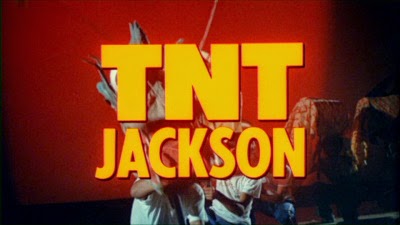
The film opens in a seedy section of Hong Kong referred to as the 'yellow section'. Okay, whatever. We see a couple of characters follow a man into a movie theater. The show AND the flick begin with someone doing the worst Bruce Lee animal style yell on record as a lion troupe perform on stage during the credits. The story is, Diana 'TNT' Jackson (Bell)arrives in Hong Kong to find her missing brother, Stag. She heads to his place in the 'yellow section' after being told it's one of the worst places to be in the city. This is underscored by a woman being sexually assaulted in an alley by one dude until someone else jumps in and snuffs him. After asking around, TNT finds herself jumped by a gang of assailants who she handles in quick fashion. She then finds that she's immediately in dutch with the main drug smuggler, Sid(Ken Metcalfe) AND his right-hand man, Charlie(Stan Shaw). This is told to her by Elaine(Pat Anderson), a woman who is on Sid's payroll. TNT eventually finds 'Joe's Haven'(yes, that is how the place is called)thanks, or no thanks, to Elaine who picks her up after the earlier fight. TNT meets Joe(Chiquito) who's practicing in a loft space above the bar because it's the '70's and all bars have a secret dojo or brothel or other business above the bar. TNT and Joe set out to infiltrate Sid's drug empire to find out what happened to Stagg and find themselves caught up in a mystery. What happened to Stag? Why is Charlie involved with Sid? Why is Elaine even there? All of this leads up to TNT bringing the beatdown.


TNT Jackson is unique because it is a flick that is certified cheese, make no mistake about it. It is representative of a period where everyone wanted the cash bonanza seen in the rise of kung-fu movies spearheaded by Bruce Lee's fame and the rise of Blaxploitation. By 1974, the 'bad Black mama' trope was already in full effect thanks to Pam Grier and Tamara Dobson. In fact, Bell herself was in Dobson's Cleopatra Jones in an uncredited role. Jeanne Bell's career is an interesting one - she became known to people as the first Black Playboy model to appear on the cover. Technically. She shared space on the January 1970 cover with four other models. But Jeanne would get the shaft as HER photo is split in half, placing her on the spine. She was the October centerfold in 1969 though. Jeanne's looks garnered her first taste of Hollywood via the popular TV series 'The Beverly Hillbillies'. One episode had her featured as part of a scheme that saw her as a harem slave girl. Yeah. From those appearances, she wound up getting her first film role in the Calvin Lockhart classic Meiinda. TNT Jackson was her breakout solo role. Aside from that, she would also be in Martin Scorsese's critical classic Mean Streets and do other films and TV shows until 1977 when she opted for love and marriage. Bell is also credited for helping a certain Hollywood duo reconcile and even helping one half of the duo get over his alcoholism. That duo? Richard Burton and Elizabeth Taylor. As TNT though, she's not entirely a knockout. Her fight scenes, like everyone else's, has a tiny bit of flash but still seems too staged. More on that later.


Another face you might recognize is that of Charlie, played by Stan Shaw. Shaw is known best by some for Harlem Nights, but his career got started in Blaxploitation. This was his second film after a bit role in Issac Hayes' Truck Turner, which was out that same year. Shaw displays a good amount of charisma here. He's probably the best actor in this picutre. Plus, he and TNT seem to be competing for best dressed in this flick. Peep every scene he's in, the vines were ridiculous. And his Afro? That may have given Afro-Sheen heavy profits that year in product placement alone. But he and Bell do make for an interesting tandem here. As far as Joe, aka Dynamite Wong? Chiquito would play this kind of role quite a lot in this time period. The Filipino actor actually is regarded as a legend in his country for his comedic roles and also his dedication to stopping a shameful depiction of Chinese-Filipinos in film and TV there. Which is also why this flick has the alternate title you see in the post heading; this is how the film was marketed in the Philippines.


That said, TNT Jackson isn't a great flick. You're going to wince more than a few times. The fight scenes are barely watchable. Bell's fighting skill is 'meh', and Shaw's prowess at times is basically viral video worthy. They do make for some unintentional comedy though. Take for example the scene where TNT is cornered by Ming, an evil boss working with Sid. Mind you, she's basically forced to fight topless. No doubt this was to get that necessary T&A quotient in there. But in that scene, her panties CHANGE COLOR. So much for continuity. And some people meet their end in this flick with some lousy reactions. And note how many times people actually MOVE before they get hit in this picture. Part of the cheesiness is highlighted by the fact that the guy that plays Sid was the SCREENWRITER. Low budget, indeed. But this film has to be seen if only to appreciate its value to the grindhouse genre.(Side note - Bell was actually part of a minor brouhaha with Martin Scorsese and the man who'd eventually produce this film, Roger Corman. Corman wanted to fully finance Mean Streets for Scorsese on one condition - that the film be an all-Black cast. Scorsese refused, but Corman never forgot Bell.) Plus, it's really a little over an hour. What can you get from this flick outside of groans and laughs? A bit of appreciation for the fact that this film is a minor counterpart to the films of the era that saw women take a greater role as action film leads, even if there were still some stereotypical elements still present. So get some wine, coffee or whatever else you like to go with cheese and peep TNT Jackson if you don't have any other way to spend an hour and change. The film is available on DVD AND Youtube.

RATING: 2 Of 5 DRAGON PUNCHES

Wednesday, April 16, 2014

The Angry River(Gui Nu Chuan, 1971)


What's happening Hai! Karate fans?!! We've got another film on deck for you, this one being the very first picture Golden Harvest Studios ever made, The Angry River! This film also boasts another first, in that it is the first starring role for the iconic screen star Angela Mao Ying!! Wong Fung is in the director's chair for this picture, which also features Pai Ying as the main villain and Kao Yuen as the assisting hero.


The story begins with a series of murders committed in ghastly fashion against various people. All of the victims are noble knights. It's soon found out that the Lunar Sect is behind it, at the behest of their leader, King Hell(Pai). Their main opponent, Liangyi Castle is determined to stop them. Lan Tin-Lung, head of the castle, rounds up other fighters willing to join the cause. But at that moment, the Lunar Sect launches a sneak attack complete with poison darts. Tin-Lung is badly wounded, and it is found that there is no cure for the poison - save for the Black Herb. The thing is, the herb is located in a valley guarded by various treacherous traps. No one has ever come back alive. Tin-Lung's daughter, Lan Feng(Mao Ying)doesn't care what the risks are. And so, she sets out to find the Black Herb.


The journey IS difficult, with Lan Feng's skills being severely put to the test. She has to cross...you guessed it, 'The Angry River' and then one of her last trials has her fighting...a monster. I kid you not, a full grown kaiju her size. After these ordeals, she winds up receiving the Black Herb but is now without any of her powers, having lost them in the fighting. She begins the journey back, accompanied by a monk (Fung Ngai) and hero Leng Yu-Han(Yuen) who had tried unsuccessfully to get the Black Herb before. And so, Lan Feng tries to get the herb back despite bandits and the evil wrought upon her by King Hell, with it all coming to a bloody conclusion.


The Angry River is a neat little film that has some kick for all of its ninety minutes. Are there some things you can find an issue in the flick? It does tend to appear a bit boring in a couple of dialogue scenes. Fans of Angela Mao may be a bit thrown off by her few fighting sequences but it IS her first real starring role. Plus, the monster bit does tend to make you chuckle instead of being terrified. That said, Angela shows why Raymond Chow took such a huge risk in casting a relative unknown to star in his first ever picture. Angela Mao was only 20 years old at the time and fresh off of the Chinese Opera scene in Taiwan. That gamble paid off as she would be one of Raymond Chow's shining stars. She displays a good sense of drama throughout, and it is intriguing to see her so helpless in contrast to her future bad-ass persona. But she does get a chance to deliver some punishment and bloodshed, notably taking someone's head clean off in a fight scene. Pai Ying does his villain thing, complete with a heavy tan. If you look closely, you will spot some familiar faces throughout. Sammo Hung features prominently as a villain in a duo with another known role actor who played a villain well, Han Yen-Ching. You will know him from The Big Boss as Boss Mi. You even have Shaw Brothers regular Wilson Tong in an uncredited role and Lam Ching-Ying as a thug is here too, padding the resume. All in all, The Angry River is decent and a good look at just how Angela Mao - and Golden Harvest - got real famous.

RATING: 3 DRAGON PUNCHES OUT OF 5

Thursday, March 27, 2014

Shaolin Mantis (Tang Long, 1978)


What's happening, all you fighting films lovers out there? Hai! Karate returns with the next post covering a Shaw Brothers flick not widely spoken of but still dope as hell, Shaolin Mantis!!! This film from 1978 stars Shaw action heartthrob David Chiang, Cecilia Wong, Lily Li Li-Li and Lau Kar Wing at the forefront of a real solid cast! Directorial duties here are by the late master Lau Kar Leung himself.


Shaolin Mantis begins in the courtyard of the Qing emperor Ping Xi (Frankie Wei-Hung) who has summoned Scholar Wei and his son, Wei Fung(Chiang). On the surface, all seems innocent. Emperor Xi asks Wei Fung to show off his kung fu, first against a Mongol fighter, and then against a Shaolin priest. (Side note: the priest is played by none other than Gordon Liu. more on that later.) After dispatching both of them, Emperor Xi decrees that Wei Fung leave his studies and go to infiltrate the Tien clan's house in order to obtain proof that they are planning to rebel. These orders come with a serious consequence; if Wei Fung doesn't return in 3 months, his family's royal standing will be stripped. 6 months, they will all be jailed. And in a year, they will all be beheaded.


Wei Fung comes to the Tien's home shortly after and winds up in a slight confrontation with Tien Gi Gi(Wong), Tien's granddaughter after she threw her elderly teacher out. Gi Gi takes a liking to Wei Fung and asks him to be her teacher. She takes him into the clan home, and Wei Fung meets all of the family including Master Tien(Kar-Wing). Master Tien gives permission for Wei Fung to stay over the protests of Gi Gi's uncles. Time passes, and Gi Gi and Wei Fung fall in love. A dangerous fact, and one Gi Gi has to reveal after Wei Fung tries to flee and is caught. The suspense builds as Wei Fung realizes time is running out for his family. He intends to leave, and take Gi Gi with him. But Master Tien and Gi Gi's family have sworn that he would not leave and are dead set against him doing so. Wei Fung manages to flee after a series of harsh fights against the clan, but loses the list. Wounded, tired and looking for vengeance, he stumbles upon a praying mantis in a thicket of bamboo, and begins to craft a new style in order to triumph. But will he succeed?


Shaolin Mantis is an underrated dramatic saga in my opinion, vastly so. It is a bit interesting to note that this film may have not been expected to do too well. One reason being that it was Lau Kar Leung's fifth film directing. He had crafted great films prior to this, Challenge Of The Masters and The Spiritual Boxer among them. They may have wondered if he could keep the magic going. Of course, having Gordon Liu do a cameo didn't hurt. This film was done shortly before the masterpiece that would launch both Leung and Liu into international stardom, The 36th Chamber Of Shaolin. Liu features prominently on the poster and the subsequent cover art on the Celestial DVD release when he's only in the film for less than FIVE minutes! That aside, Leung put together a great film. David Chiang is superb as Wei Fung, the conflicted Qing spy. This film was done as he was in the later years of a long career with Shaw. His rakishly handsome looks still worked for him, although in some shots you can see his age more prominently. His fighting talents are in full display here. especially his acrobatics which Leung made sure would be put to the max. Cecilia Wong as Gi Gi shines, deftly making you feel sympathy and warmth as she becomes less of a brat and more of a tragic figure, loving her husband but trapped against her clan. Lau Kar Wing as Master Tien does well enough to not just be a stock villain. Lily Li as Gi Gi's mother gives another great role justice; she would prove to have a knack for these roles throughout her career. Add Wilson Tong and Norman Chu as Gi Gi's uncles and you've got a cast that solidifies the film. As far as the fighting, while it is less than you might expect from a Shaw film, what is there balances the film's dramatic plot out well. One would have like to see more of the mantis style training scenes later in the film, but it is good enough without that. And the plot twist at the end is 'WTF' enough to seal the deal. There may be one or two moments where you'll find your focus wavers but Shaolin Mantis is strikingly good. Check it out when you can, it's out on DVD and online.

RATING: 3.5 of 5 DRAGON PUNCHES

Saturday, March 22, 2014

Shorinji Kenpo (The Killing Machine, 1976)


Next up for all you martial arts film lovers out there thanks to Hai! Karate is a Shinichi 'Sonny' Chiba joint that doesn't get quite the accolades it deserves, Shorinji Kenpo, from 1976!


Shorinji Kenpois essentially a biography of the art's founder, Doshin So. So is, like other founding masters of martial arts, a figure stepped in legend and legacy. So was born in Okayama, Japan in 1911 and at the age of 17 he went to live in China. Why? He was working for the government as a secret agent. While there, So fit in well enough to be involved with several Chinese secret societies. This would then put him in contact with martial artists who had been in hiding since the Boxer Rebellion years earlier. He began to learn from them, specifically training with a Shaolin master by the name of Wen Laoshi. He would succeed Laoshi as master of the Northern Shaolin Giwamonken School. Using this style and other techniques, he gave birth to shorinji kempo, which translated means 'Shaolin Temple Fist Method'. He returned to Japan in 1946 and saw that the country was in ruin and moral disrepair after their defeat in World War II. He then committed himself to helping to boost morale and pride by reaching out to the youth in talks, then by establishing a dojo via the formation of a temple, getting around the Allied forces' decree that no martial arts be taught in post-war times.

With a story like that, it's no wonder Toei wanted to do a film on So. And they had the man to do it, Sonny Chiba. Chiba was riding high as Japan's #1 action star. The film essentially has him playing Soh during this period as he returned to Japan to find his way. The film begins with Soh escaping a gang of Chinese fighters only to get to base and find that Japan has surrendered to the U.S. He reacts by shooting up the entire office in rage.


So returns to Japan, and along the way dispenses justice against some soldiers looking to rape a young girl named Kiku(Yutaku Nakajima)and to stop Korean bandits on a train in rough fashion. So's whole persona is that of dispensing justice and living with honor even in the worst of times. He eventually finds a home in the slums of Osaka amid orphans and prostitutes underneath a railway. There he's charitable and helps to settle disputes, one of which has him reunite with Kiku and her brother. Kiku had become a prostitute, forced by the Russians. But with So and the the orphans, she runs a food stand. The happiness doesn't last long as her brother gets hit by an American jeep and So proceeds to bust heads.

While in prison, he befriends a man named Otaki(Makoto Sato) who he had beaten up before in a melee with black market smugglers. Of course, this is after he sends Otaki RIGHT THROUGH THE WALL with one kick. So winds up getting freed by the prison warden on the condition he leave Osaka. He does and hits a seaside town, Tadotsu. There he solidifies his rep as 'Crazy Dog', but also gains enough support to build up his dojo while waging war on the local yakuza. It all comes to a head once one of his prize students, Tomoda(Naoya Makato) and his sister (Etsuko Shiomi) are set upon by yakuza thugs who slice off Tomoda's arm. The battle is now on in earnest as So begins to define not only his purpose, but that of Shorinji Kempo.


Shorinji Kenpo is a surprisingly compelling film. It is a shame that Western markets chose to dub it 'The Killing Machine' because it gets away from the heart shown in the picture. For starters, it's a sobering look at Japan's disrepair after World War II in all forms. It's not hokey in the least. The storyline may have its highly cinematic parts but it also has tear-jerker moments. Otaki's storyline is painful in the picture. Kiku is also a tragic figure. But there is triumph of the will here, evidenced by So and Tomoda, who despite losing an arm, finds the courage to still fight and train. Shorinji Kenpo benefits from this, as well as its many well-done and thrilling fight scenes. So himself was the primary film fight instructor, thus keeping the integrity in the action. And there is a lot of it. Be warned though - there is visible blood-letting in the flick, including one scene that... well for the fellas, I'd advise you to really cringe in one scene where So dispenses justice in a crude way. That ends with a stray dog. Yeah. Shorinji Kenpo is probably one of Chiba's best flicks in that it is one of his most balanced. And Chiba's acting doesn't go over the top here, befitting the man who he portrays. Go peep Shorinji Kenpo as soon as possible.

RATING: 4.5 of 5 DRAGON PUNCHES

Monday, February 24, 2014

Masked Avengers (Cha Shou, 1981)


Hello folks, we're going to cover one of the all-time great martial arts movie classic here on Hai! Karate and that is none other than Masked Avengers!!! This flick is another one of the films that stars the actors that make up the famous Venoms crew, but in a decidedly different way. And it's also another project from the legendary Cheng Cheh as director.


The movie begins with something unusual for the Shaw films up to this point; simple titles that focus on the scary bearded masks and tridents of the Masked Avengers gang. It gives the film it's dark, edgy feel right away. The story begins with the Masked Avengers tracking down another of their victims they've been hired to kill.(No mention is made of who hires them ultimately throughout the picture.)One of the victims gets away and finds Qi Shanyung(Chiang Sheng)and other heroes to tell them what happened. Shanyung along with Zeng Jun(Chin Siu-Ho) and Liang Rong(Chu Ko) have gathered the heroes from different clans together to stop the Masked Avengers gang and their devilish deeds. And 'devilish' is the right word to use; the gang is a bunch of sadistic, crazed mercenaries who drink blood and take joy out of killing. Case in point? The first scene in their hideout shows them drinking the blood of a chicken. Disliking this, the chiefs then unveil a discarded Buddha Statue and throw a trident at the exposed midsection. Then they push a button and reveal that it's another victim STILL ALIVE in the statue. Gory stuff.


Qi Shanyung and crew find themselves in a town near where the Masked Avengers are suspected of hiding. They begin to investigate two powerful lords who are rivals in the town, Lin Yunzi(Lu Feng) and Fang Zanguang(Wong Lik). They make their base in a local inn and find a suspicious figure in the cook Gao Yao (Philip Kwok)who Zeng Jun winds up befriending with some resistance by Yao. This sets the scene for some serious intrigue and inevitable action up ahead with a couple of twists you don't really expect. And the final fight scene brings it all to a head in the abandoned temple hideout of the Masked Avengers!!


Masked Avengersis one of the most acclaimed kung fu films...but it didn't make a ton of money when it first came out. In fact it was considered a box office failure and could have been one of the films that made Sir Run Run Shaw think long and hard about his film empire's dwindling future. Audiences may also have had mixed feelings because while this is a film associated with the crew of actors who played the Venoms, not all of them are here in this flick. Lo Meng had left by this time, and Sun Chien for some reason wasn't available. Chin Sui-Ho fills in admirably as Zeng Jun. This was one of Chin's few roles as a leading actor for Shaw. He displays enough heroic charisma and a bit of comedic charm. It fits here as he tries to make friends with Gao Yao and solve the case. He'd go on to have a couple of more lead roles and star in a couple of notable Jet Li flicks, most famously as his friend turned rival in The Tai Chi Master in 1993. Chiang Sheng takes on a more serious role as Qi here in a departure from his comically-tinged prior roles. The standouts though are Lu Feng and Philip Kwok. Feng hit his stride as a master villain here. His first appearance in the flick though is a bit hilarious, manicure and all. It doesn't betray just how foul of a villain he proves to be in the flick. Philip Kwok as Gao Yao is masterful as the brooding chef with a secret. His acrobatic maneuvers here are among some of his best work.


You'll note that Masked Avengers has a scant female presence in the film save for a couple of attendants to Ling Zunyi, a woman who is abducted and raped mercilessly by the gang and the 'meditating wenches' seen in the inner temple sanctum - butt naked. Again, Cheh stuck with his own code of feeling that women were merely plot devices here. Another point is just how DARK this film can get. Drinking blood and rape, along with religious symbols being used as torture devices are pretty ill factors for a film. It gets even more twisted once you get to the final fight scene. In some ways that scene is worth some of the drawn-out intrigue earlier in the picture just because of the heroes' fight to get there, only to be met with each of the chiefs entering the fray by being lowered from the roof into the inner chamber, spy movie style. Slightly cheesy? Perhaps but you'll get a kick out of it. Especially when the acid plays a part. You won't even mind how Zunyi gets his, even if it seems a bit unreal. But that is the beauty of Masked Avengers; it employed a ton of great action thanks to Kwok, Sheng and Ko's fight direction along with great set design and a plot that moves quickly in a deceptive way. The entire film takes on a radio serial feel of suspense, and even tips its hat to comic books. A side note: the soundtrack is in part taken from the sci-fi dystopia hit Mad Maxreleased two years earlier. There is a distinct level of bloodiness here, which was increasingly due to both Cheh's own machinations and an appeal to get more audiences used to seeing it in other pictures of the time. The gang drinking blood repeatedly, a member visibly biting off his own tongue to avoid talking among other scenes make this one of the more rougher Shaw pics. But it is all worth it. Make Masked Avengers one of your must sees if you haven't already.

RATING: 4.5 of 5 DRAGON PUNCHES

Wednesday, January 29, 2014

One Armed Swordsman (Du Bi Dao, 1967)


The next flick we've got for you here at Hai!Karate is a classic staple for all lovers of fight cinema, One Armed Swordsman!! This film stars Jimmy Wang Yu, Lisa Chiao Chiao, Tien Feng and Ku Feng among others. The legend Cheng Cheh sits in the director's chair for this film from Shaw Studios.


One Armed Swordsman opens with a group of villains entering the manor of Qi Ru Feng (Tien)with the purpose of defeating him and the Golden Sword School. His servant Fang Cheng(Feng) valiantly fights them off, and is mortally wounded. Before he passes however, Master Qi Ru Feng swears to take his son Fang Gang in. We fast forward to seeing Fang Gang(Wang Yu)all grown up, tending to the estate and learning from Teacher Qi. Teacher's daughter Qi Pai Er (Violet Pang Zi-Yi)is a spoiled little thing who alternates between dislike and liking Fang Gang. Fang Gang? He mostly remains aloof. After a good deal of being picked on, Fang Gang, rather than be the source of any unrest in the school, decides to leave one night. Pai-Er and two other classmates track him down and claim he's dishonoring the school by running away. (Seriously?)Pai-Er decides she wants to scrap, and Fang Gang deftly blocks her attacks and knocks her over as if to say, 'Silly Rabbit.' Pai-Er cries, embarrassed. So much so that when Fang Gang tries to help her up, SHE CUTS THE HOMIE'S ARM CLEAN OFF. Cue the wild dramatic music sequence. After he stumbles off into the snowy forest hinterland, Teacher comes up and just scolds everyone in the trio. That's it. He just yells at them.


Fang Gang stumbles and stumbles until he falls off a bridge...into the boat of Xiao Man(Chiao Chiao)She slowly nurses him back to health and in doing so, falls in love with him. After he heals, Fang Gang and Xiao Man are discussing the future when two rowdies start harassing Xiao. Gang tries to fight them off to no avail. They're only stopped when Master Smiling Tiger(Tong Dik) waves them off. Xiao Man, against her own dislike of martial arts, gives Gang a sword manual left to her by her father. Due to a fire, all that's left are left-handed sword techniques. Meanwhile, Smiling Tiger, the sworn enemy of the Golden Sword School, has unleashed a new weapon that can defeat the school's 64 techniques called a sword lock. With this, Smiling Tiger and his pupils go on to terrorize Qi Ru Feng's students. That is, until Fang Gang shows up. He soon realizes the fate of the Golden Sword School is in his hands. And along the way, he gets to throw some serious shade to Pai-Er who's still acting bratty.


One Armed Swordsman is a highly acclaimed martial arts film and it's a groundbreaking one on a couple of levels. First, it was the first Hong Kong film to gross one million dollars due to its popularity. The next point of appeal lies with its charismatic young star, Jimmy Wang Yu. Jimmy was just setting out on the apex of his flashy and lengthy career, a far cry from being a swimming champion. It's worthy to note that he had NO martial arts training whatsoever. Yes, that's right. None. He looked the part thanks to the action direction of the great Lau Kar Leung(who you can spot as an extra in the flick)and Runme Shaw himself. Wang Yu would go on to utilize the one-armed style effectively throughout his career, even going up against famed Japanese character Zatoichi in a 1972 flick. And lastly, the style that Chang Cheh brought to One Armed Swordsman was the beginning of a new wave taking place in Hong Kong cinema. It was a wave that borrowed from the chambara genre wildly popular in Japan. It also owed some influence to westerns by Sam Peckinpah and Sergio Leone. You can see it in the camera angles and precise editing jumps, whereas in previous films most shots were long drawn out set pieces and takes. Take note also on how the film backdrop by Johnson Tsao helps tell the Story of Fang Gang's development from the harshness of losing his arm in winter to his return to the Golden Sword School to face Smiling Tiger in the summer.

Of course, there are a few things that catch you off guard. For one, Pai-Er seems to have been an early ancestor to those broads you see on shows like 'Bad Girls Club'; always upset, hiding her true feelings in certain rash moves. Xiao Man doesn't fare that much better even in a sympathetic love interest role. She tends to fall over herself weeping a lot. Given the charges against Cheh's depiction of women that we've spoken of on this blog, this seems to be ground zero for it. 'Dames can't be trusted.' This also is possibly a reach back to Hollywood cinema in the days of film noir. And after Fang Gang gets his arm cut off - how did this cat not pass out right there on the road? The sword lock is another curious point, but one you can overlook for the sake of the film. It also would be the origin point for Chang Cheh's love of crazy-ass weaponry.


If you haven't seen it yet, make it a point to watch One Armed Swordsman. You get a better understanding of the beginnings of Chang Cheh and his style that would become synonymous with the Shaw Brothers Studios for the next couple of decades afterward. And it's a nicely paced action film with enough captivating drama no matter how often you watch it.

DRAGON PUNCHES: 4.5 out of 5